
Women's Health
For years, you thought something was wrong with you. The problem wasn't her body, but the type of stimulation.
Only 18% of women reach orgasm from intercourse alone. What the rest are missing can be explained by anatomy - and it can be addressed.
“I can't reach orgasm during sex; actually, if I'm being honest, I don't feel anything at all during intercourse." This sentence didn't come from a sexologist's office. A woman wrote it on an anonymous forum and added: “I'm sad and disappointed, and I get depressed when all my friends talk about how great it is."
Below it, another woman wrote: “My mind is always somewhere else and I can't relax. Apparently I have to learn to make myself come first, and only then with a partner." And another, a woman in her thirties: “I can't switch my mind off; orgasm doesn't seem even remotely possible, so I don't really enjoy sex either."
If you found this text through a search, you probably know that feeling. It isn't rare. According to a representative Indiana University survey from 2018, 18% of women reach orgasm from intercourse alone. The remaining 82% need something that is often missing from ordinary sex. This article is about exactly what that is.

Three pieces of advice you've already received
Most women who post on a forum have already tried what they were advised to do. Three suggestions come up again and again.
First: “don't think about anything and relax." One participant summed it up perfectly: “It's easy to say, don't think about anything." The advice fails because it reverses cause and effect. Her mind doesn't switch on because she is too stressed - it switches on because her body isn't receiving enough continuous stimulation for arousal to build. When nothing is happening, the brain starts observing, evaluating, and measuring time. Trying to relax without physical input is like waiting for a train at the wrong platform.
Second: a new position, longer foreplay, better partner technique. “Try a position where you're on top and you control the pace and type of movement." This helps the minority - those who can reach orgasm from intercourse. For most women, the problem is mechanical: penetration stimulates the clitoris only indirectly, through the movement of surrounding tissue. Changing the angle doesn't change the fact that the most sensitive part of the body is receiving second-hand stimulation.
Third: fingers or a conventional vibrator. This gets women closer. “I didn't feel anything either... it only helped when I found the courage, picked up a vibrator, and started experimenting on my own." But many give up after a few attempts: direct pressure on the tip of the clitoris is too sharp, it becomes numb after a minute, the hand gets tired, and the intensity fluctuates precisely when it needs to remain steady. The result: “there was something," but no orgasm. And another piece of evidence that something is wrong with her.

The common denominator
There isn't one. These three failures don't have a shared psychological cause or a shared problem with the partner. They have a shared type of stimulation - where, how, and for how long. The Indiana University survey quantified this in a sample of 1,055 women aged 18 to 94: 36.6% of women need direct clitoral stimulation to reach orgasm at all, and another 36% said orgasm is significantly better with it. Together, that's three-quarters.
Sex educator Betty Dodson, who spent decades answering letters from women with exactly this question, spoke of twenty to thirty minutes of appropriate clitoral stimulation as a normal need. Not a disorder. A norm that most sexual situations simply don't meet.
Why the type of stimulation matters more than anything else
To understand why the three pieces of advice above fail, you need to know what the clitoris actually looks like. What you can see is only the tip. The clitoris is an organ that continues inside the body: two legs surround the vagina on both sides, and two bulbs lie along its walls. During arousal, this entire structure fills with blood and enlarges, much like erectile tissue in men. Most of the organ is beneath the surface - and so are most of its nerve endings.
1. Location
This leads to the first point: penetration stimulates the organ only indirectly, through the movement of surrounding tissue. For some women, that is enough. For most, it isn't - the figures above are not an opinion; they are the results of a representative sample. When a woman writes that she “doesn't feel anything at all" during intercourse, she isn't describing a disorder, but anatomy: the stimulation is missing the place where the tissue is most sensitive.
2. Time and continuity
A woman's arousal isn't a switch; it's a curve. Blood flow, tissue tension, and sensitivity rise gradually and need continuous, rhythmic input. Every interruption - a change in rhythm, a tired hand, a pause to “try it differently" - doesn't stop the curve, but drops it lower. This is where the feeling of “I was so close, and then suddenly nothing" comes from. And this is where the mind switches on: the brain registers that nothing is happening and starts commenting. “I can't switch my mind off" is, from this perspective, a consequence, not a cause.
3. Type of touch
The tip of the clitoris is the most sensitive place on the body. Direct frictional pressure - from a finger or a conventional vibrating head - affects it like a loud sound affects the ear: an intense sensation at first, then numbness. The nervous system adapts to a monotonous stimulus, sensitivity drops, and the woman adds pressure, only deepening the numbness. That's why women write that after a while they “can't feel anything" even with a vibrator. It isn't a lack of sensitivity. It's too much of the same kind of stimulus on too small an area. And when numbness combines with hand fatigue and a fluctuating rhythm, the curve from the second point drops precisely when it should be rising - all three problems converge in one minute.
There is a type of stimulation that addresses all three points at once: air pressure waves. Instead of friction, gentle rhythmic suction and pressure are created above the tip of the clitoris - the tissue is lightly drawn in and released many times per second, without direct contact with the most sensitive spot. The stimulation is transmitted into the tissue beneath the surface, not just to the tip. That's why women often describe it as completely different from vibration - at first “like a warm breath," gradually changing into pressure.
There are three important consequences. Without friction, sensitivity doesn't become numb in the same way, so stimulation can last twenty minutes or more. The rhythm is mechanically constant - it doesn't change with hand fatigue or a partner's mood, so the arousal curve rises without drops. And because the device does the work itself, the brain has nothing to control or evaluate; the mind doesn't switch off through willpower, but because it has no reason to intervene. One reviewer who had used conventional massage heads for years described the difference as reaching the edge in six minutes instead of a few seconds - and being able to stay there for as long as she wanted.
One caveat belongs in an honest account of this topic: a body accustomed to a different type of stimulus needs time to get used to air pressure waves. One reviewer wrote that her body was “so unaccustomed to the feeling of suction that the orgasms last longer." Some women need several attempts and the lowest intensity before finding the right placement. That isn't a failure of the method, but part of learning a new type of input - just as with any stimulus the body hasn't experienced before.
“I can confirm that once I achieved it on my own for the first time, it worked with my partner too. The first time, I managed it with a clitoral stimulator." forum participant, Modrý koník
What it looks like in practice

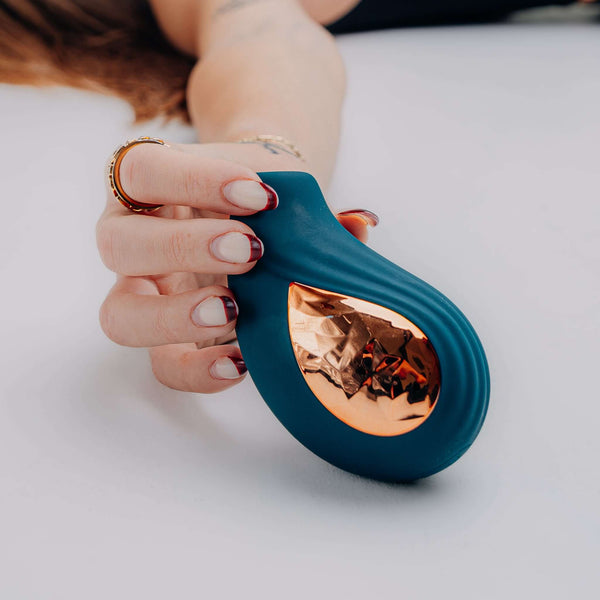
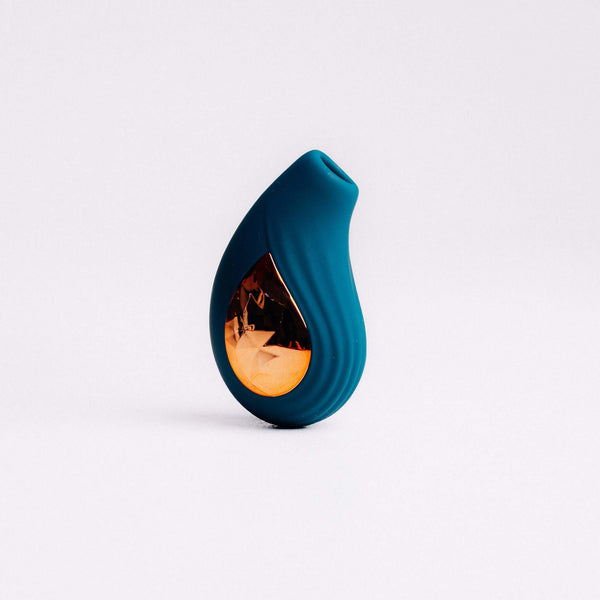
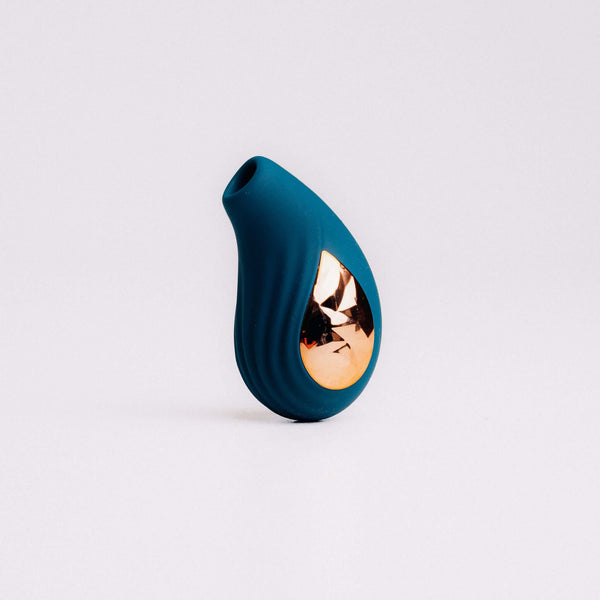
Devices based on this principle are known as air-pressure clitoral stimulators. EMERALD GOLD air-pressure clitoral vibrator is one of them, designed specifically for the situation described above: five suction levels, from a gentle breath to a strong pulse, so you can genuinely start low, plus ten vibration frequencies that can be added when your body wants more. The soft silicone opening is placed over the clitoris and doesn't require precise aiming. The body is water-resistant (IPX6), so it can also be used in the shower, where it is easier to relax, and the motor is quiet. It charges with a magnetic USB cable. It is sold by a Slovak online store for €38.99 and shipped in discreet packaging with no indication of the contents.
What women object to - and what the numbers say
“It won't work for me either." According to the same survey, direct clitoral stimulation is a route to orgasm for three-quarters of women. One forum participant put it directly: “The vast majority do eventually experience orgasm with this type of toy."
“It will be too intense." That's why there are multiple levels. Reviewers recommend starting at the lowest and increasing only just before the peak.
“What if it doesn't suit me?" The 90-day money-back guarantee means that if you aren't satisfied, you'll receive a full refund within 90 days. Average rating: 4.8 out of 5 from 311 customers.
“I'm embarrassed to order it." The package has no indication of its contents and ships within 24 hours. The device itself looks like a cosmetic product - the drop shape was chosen so no one can tell what it is.
If, after reading this, you think your problem has always been the type of stimulation rather than anything wrong with you, here's a more detailed description of the device and experiences from women who use it. You can read it with no obligation, just as you read this article.
Read the description and experiences- Herbenick D. et al. (2018). Women's Experiences With Genital Touching, Sexual Pleasure, and Orgasm: Results From a U.S. Probability Sample of Women Ages 18 to 94. Journal of Sex & Marital Therapy.
- Discussions on the Modrý koník forum: “I Can't Reach Orgasm," “Problem Reaching Orgasm," “Girlfriend Can't Reach Orgasm" (2022–2026). Quoted verbatim, anonymously.
- Dodson B., reader letters and responses (dodsonandross.com), 2015–2017.
- Reviews of air-pressure clitoral stimulators: Girly Juice (2017), polyammering (2017), Mumsnet Reviews (2025).